
Common Applications of 3D Scanners Across Industries
Common Applications of 3D Scanners
The versatility of 3D scanners spans multiple industries, revolutionizing traditional processes and unlocking new possibilities for innovation. Below are some common applications where 3D scanners play a crucial role:
Manufacturing and Quality Control:
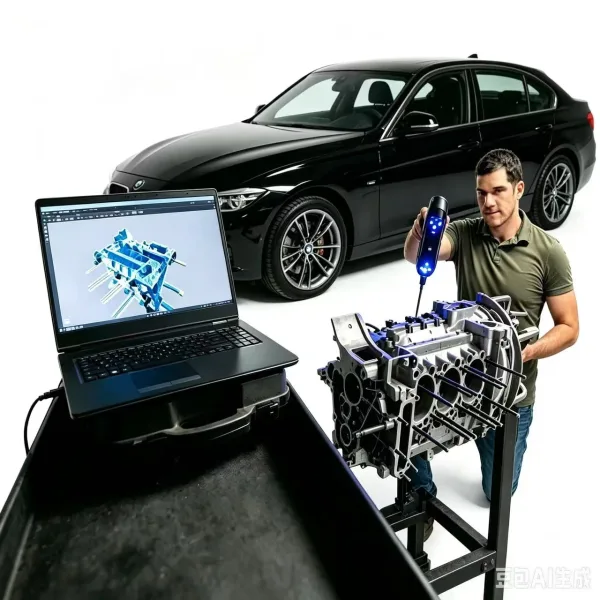
3D scanners are indispensable in manufacturing, used to inspect and ensure product quality. They enable fast and accurate assessment of components, identifying defects or dimensional variations. This application streamlines production workflows and maintains strict quality standards.
Reverse Engineering:
In product design and engineering, 3D scanners are employed for reverse engineering. By capturing the geometric shape of existing objects, engineers can reconstruct and modify parts, facilitating product improvements and innovation.
Medical and Dental:
In healthcare, 3D scanners help create customized medical devices and prosthetics. In dentistry, intraoral scanners capture precise dental impressions, improving the efficiency of procedures such as crown placement and orthodontic treatments.
Archaeology and Cultural Heritage:
Archaeologists and conservation experts use 3D scanners to digitize artifacts and historical sites, preserving these cultural treasures for future generations. This technology supports documentation, analysis, and restoration efforts, offering a non-invasive method to study and share heritage.
Art and Design:
Artists and designers use 3D scanners to bring their creations to life. Whether replicating sculptures, capturing intricate details of digital art, or integrating real-world objects into virtual designs, 3D scanners serve as invaluable tools for creative expression.
Construction and Architecture:
In construction and architecture, 3D scanners help capture as-built conditions and generate accurate building models. This simplifies planning and design phases, enhances project accuracy, and aids in renovations or facility management.
Education and Research:
3D scanning technology has entered education, allowing students to explore and understand complex concepts in tangible ways. Researchers across disciplines use 3D scanners for data collection, analysis, and visualization.
Custom Manufacturing and 3D Printing:
3D scanners are essential in custom manufacturing, enabling the creation of tailored products based on scanned data. Additionally, scanned models can be directly used for 3D printing, making prototyping and small-scale production more accessible.
These applications represent only the tip of the iceberg regarding the broad potential offered by 3D scanning. As we delve deeper into this comprehensive guide, we will examine in greater detail the factors to consider when selecting a high-quality 3D scanner and address common questions about this transformative technology.