
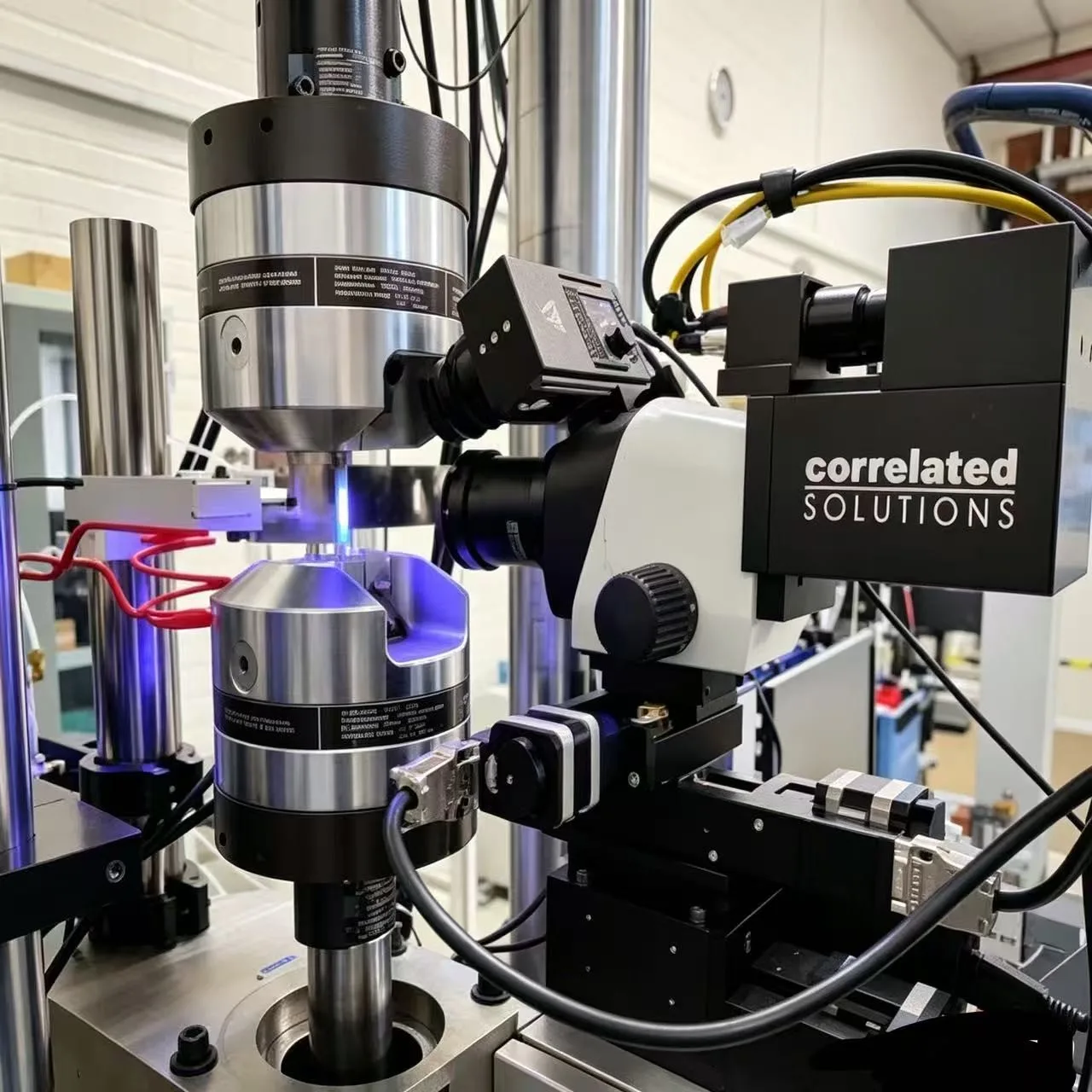
VIC-3D Stereoscopic Microscopy System
VIC-3D Stereoscopic Microscopy System
Item No.: VIC-3D
The VIC-3D Stereoscopic Microscopy System is a high-precision optical system designed for measuring the surface shape, deformation, and strain of micro-scale specimens under applied loads. By integrating a stereomicroscope with a high-resolution machine vision camera, a custom beam splitter, a precise 3-axis electric (or manual) stage, and advanced distortion-correction software, this system enables high-magnification measurements with exceptional accuracy.
Applications
This system is ideal for measuring strain in composite fibers, solder joints, electrical components, biological materials, and other micro-scale specimens.
Addressing Measurement Challenges
Traditional methods often struggle to obtain three-dimensional DIC measurements on samples requiring high magnification due to the lack of optical elements with sufficient depth of field to capture two high-magnification images from different perspectives. Stereo microscopes overcome this depth-of-field limitation, but their complex optical systems introduce distortions not accounted for in standard calibration methods. Without correction, these distortions can lead to significant errors in shape and strain measurements, often exceeding several thousand micro-strains.
Solution: 3D Distortion Correction
Correlated Solutions has developed an easy-to-use calibration method that corrects the complex, non-radial optical distortions inherent in stereomicroscopes. This method completely eliminates shape and strain deviations, ensuring reliable measurement data.
Key Features
- Zoom range (field of view): 0.8 mm to 8 mm
- Full-field measurement of 3D coordinates, displacement, velocity, and strain
- Automatic calibration using an electric stage
- Easy zooming between 1x and 8x magnification
- Independent optical path adjustment for optimal image overlap
- Powerful visualization tool with outline display overlay on sample images
- Data export in Tecplot/ASCII, Matlab, and STL formats
- Node data extraction for finite element analysis verification
Related Products
Flatness Measuring Machine
Item No.TOPOS 100Triathler Multilabel Tester
Item No.TriathlerSense Beta Plus Microplate Reader
Item No.Sense Beta600SLe automatic TDCR liquid scintillation
Item No.Hidex 600 SLe